
Find below EMERGE’s news articles, press releases, digests of scientific publications, as well as other outreach materials.
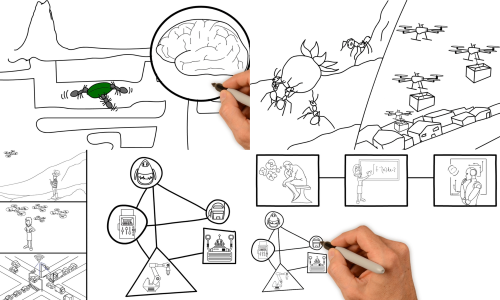
EMERGE consortium launches first project video
 20 June 2023
How do robots in a collective know what the group as a whole is doing? When intelligence is distributed across many parts, it can be tricky for the bigger picture to emerge. Yet answering these questions is key to making collective systems that are easy to design, monitor and control.
Publication: The Ethics of Terminology: Can We Use Human Terms to Describe AI?
08 June 2023
In her article published in the journal Topoi, EMERGE partner Ophelia Deroy, from Ludwig Maximilian University (DE), critically evaluates various reasons for using these terms, including ontological, legal, communicative, and psychological arguments.

Publication: Interacting with agents without a mind: the case for artificial agents
07 June 2023
In this review, EMERGE partners from Ludwig Maximilian University of Munich explore whether and when people consider — perceive, understand, predict, and manipulate — AI as non-human or human agent, utilising the socio-cognitive and interactive repertoire reserved for humans.
International Graduate School on Control of Soft and Articulated Elastic Robots
05 June 2023
About 40 registered PhD students and Post-docs from different European countries participated in the course taught by EMERGE partner Cosimo Della Santina (Technical University of Delft, The Netherlands) and Alessandro De Luca (DIAG, Sapienza University of Rome).
![[In the Media] Avvenire: Ideas. Every intelligence (artificial and otherwise) requires ethics](https://eic-emerge.eu/uploads/_crop/EMERGE_website_thumb1_crop_979cb0f770bc2846a152660c8c7d8f9a.jpg)
[In the Media] Avvenire: Ideas. Every intelligence (artificial and otherwise) requires ethics
04 June 2023
The EMERGE Project and the theme of artificial agents awareness is analysed and debated by Vincenzo Ambriola in a recent opinion article in the Italian newspaper Avvenire.

International Workshop on eXplainable Knowledge Discovery in Data Mining
30 May 2023
EMERGE partners from UNIPI are organizing the “5th International Workshop on eXplainable Knowledge Discovery in Data Mining (XKDD 2023)” during the next European Conference on Machine Learning and Principles and Practice of Knowledge Discovery in Databases (ECML-PKDD 2023), to be held in Turin, Italy, on September 18th, 2023.
International Workshop on Pervasive Artificial Intelligence
26 May 2023
EMERGE partners from UNIPI are organizing the “2nd International Workshop on Pervasive Artificial Intelligence” during the next European Conference on Machine Learning and Principles and Practice of Knowledge Discovery in Databases (ECML-PKDD 2023), to be held in Turin, Italy, on September 18th, 2023.
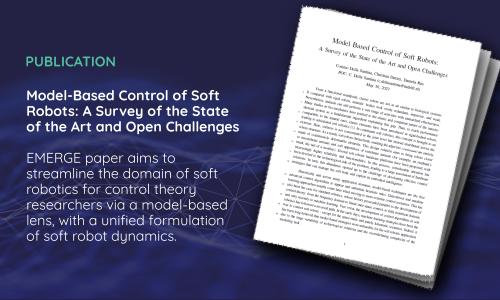
Publication: Model-Based Control of Soft Robots: A Survey of the State of the Art and Open Challenges
25 May 2023
In their paper published in the IEEE Control Systems Magazine, EMERGE partner Cosimo Della Santina, from the Delft University of Technology (NL), and collaborators aim to streamline the domain of soft robotics for control theory researchers.
Workshop Deep Learning meets Neuromorphic Hardware
24 May 2023
EMERGE partners from UNIPI are organizing a workshop entitled "Deep Learning meets Neuromorphic Hardware" during the next European Conference on Machine Learning and Principles and Practice of Knowledge Discovery in Databases (ECML-PKDD 2023), to be held in Turin, Italy, on September 18th, 2023.