
Find below graphics, videos and other outreach materials.

The EMERGE Project - Final Video
In our final video below, EMERGE partners present how the project started from a fundamental question about artificial awareness, but ended with very concrete results: new robotic systems and more sustainable AI architectures for building artificial systems that are more efficient, sustainable, collaborative, and imbued with human values.
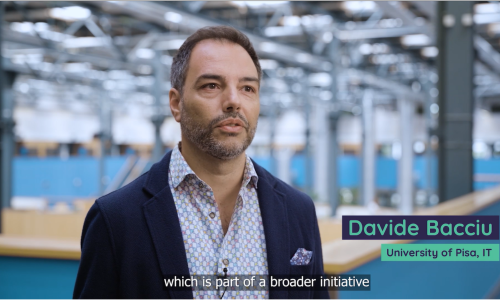
Final Interview with Davide Bacciu
Davide Bacciu, professor at the University of Pisa and coordinator of the project, explains how EMERGE started from a fundamental question about awareness, but it has ended with very concrete results: new robotic systems, more sustainable AI architectures, new startup initiatives and follow-up projects that are already carrying forward the idea of building artificial systems that are more efficient, sustainable, collaborative, and imbued with human values.
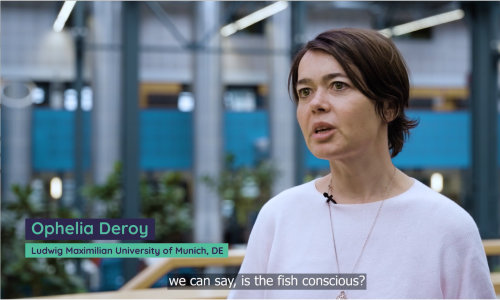
Final Interview with Ophelia Deroy
Ophelia Deroy, philosopher and cognitive scientist at LMU Munich, explains how EMERGE established a fundamental distinction between awareness and consciousness. Awareness is understood more operationally, as the capacity of an agent to process and integrate information in a way that is relevant to its actions. The project’s experiments showed that people can actually understand an artificial system as aware without assuming that it has subjective experience.
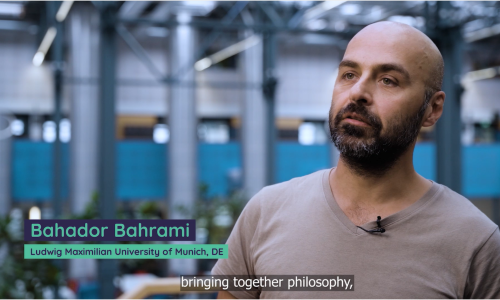
Final Interview with Bahador Bahrami
In the video below, Bahador Bahrami, director of the Crowd Cognition group at LMU Munich, explains that EMERGE’s work also examined the ethical side of human interaction with collaboratively aware systems with important implications for future environments in which groups of humans and artificial agents will have to interact, negotiate and cooperate.
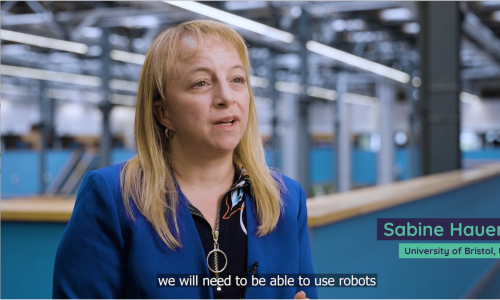
Final Interview with Sabine Hauert
In the video below, Sabine Hauert, professor at the University of Bristol, explains EMERGE’s approach where robots operate in a distributed way. This way systems that can scale to large numbers of agents and remain operational when individual robots fail or conditions change. It also allows humans to interact with the systems as a coordinated collective rather than controlling each robot separately.
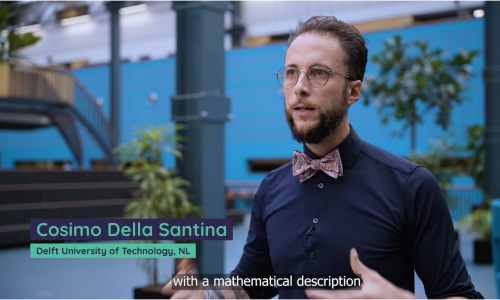
Final Interview with Cosimo Della Santina
Cosimo Della Santina, associate professor at TU Delft, explains how EMERGE developments allow robots to understand how their actions affect the world, anticipate what people and other robots are doing, and adapt accordingly. That is a key step toward robotic systems that can operate more autonomously and work naturally alongside humans.
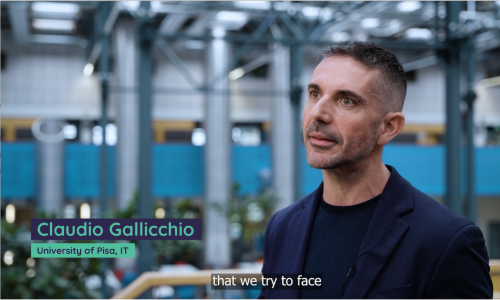
Final Interview with Claudio Gallicchio
Claudio Gallicchio, associate professor at the University of Pisa, explains how EMERGE’s results open the way to a more decentralized and environmentally sustainable models, in which data can be processed locally using small and energy-efficient devices, such as neuromorphic hardware, reducing energy consumption, network traffic and latency while improving privacy.
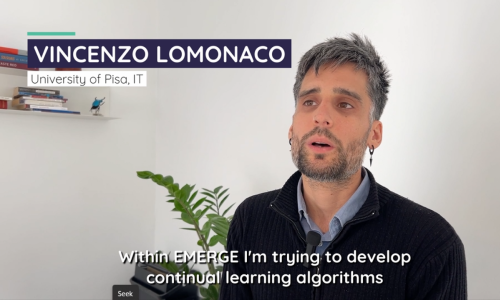
Interview with Vincenzo Lomonaco
EMERGE partner Vincenzo Lomonaco talks about his work developing continual learning algorithms that enable collectives of agents to adapt to new circumstances while preserving learned capabilities.
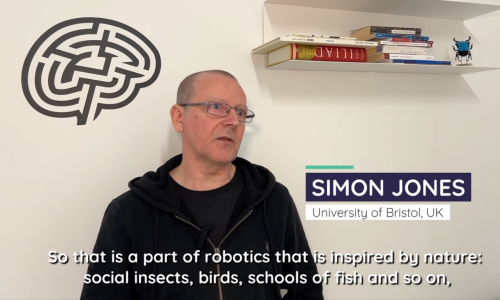
Interview with Simon Jones
EMERGE partner Simon Jones talks about his work on swarm robotics, studying how groups of robots can cooperate to perform tasks beyond the capability of a single robot.